
One of the most important topics in any discussion of networking is IP addressing. An IP address is a numeric identifier assigned to each machine on an ip network. It designates the specific location of a device on the network.
An IP address is a software address not a hardware address.
IP address was designed to allow host on one network to communicate with a host on a different network regardless of the type of LANs the host are participating in.
First of all I'm going to explain you the fundamentals of ip addressing and its terminology.Then you will learn about the hierarchical ip addressing scheme and private ip addresses.
IP TERMINOLOGY
We will learn about several important terms for understanding the internet protocol. Here we go.....
Bit:- A bit is nothing but one digit it is either 0 or 1.
Byte:- A byte is a 7 or 8 bits, depending on whether parity is used. we will assume it as 8 bit.
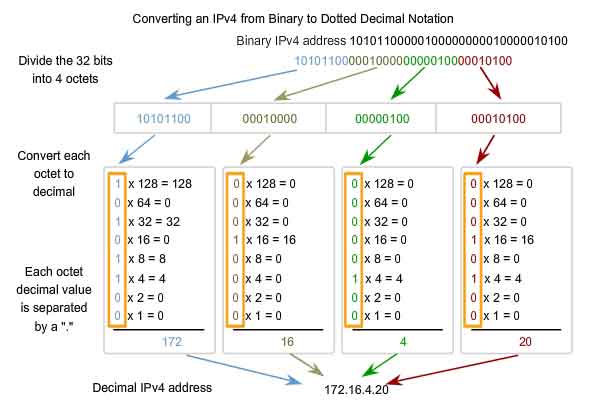
Octet :- An octet made up of 8 bit is just an ordinary 8 bit number.
NOTE: Byte and octet are interchangeable.
Network Address This is the designation used in routing to send packets to a remote network.
Example: 10.0.0.0 , 172.16.0.0, 192.168.1.0
Broadcast address :- The address used by application and hosts to send information to all nodes on a network is called broadcast address.
Example 255.255.255.255
IP Address Classes
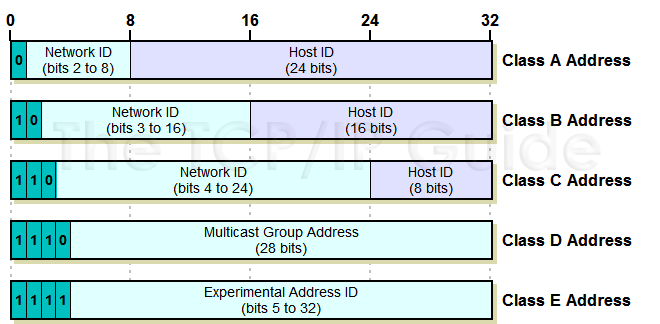
Class A
1 – 127 (Network 127 is reserved for loopback and internal testing)
Leading bit pattern 0 00000000.00000000.00000000.00000000
Class B 128 – 191 Leading bit pattern 10 10000000.00000000.00000000.00000000
Class C 192 – 223 Leading bit pattern 110 11000000.00000000.00000000.00000000
Class D 224 – 239 (Reserved for multicast)
Class E 240 – 255 (Reserved for experimental, used for research)
Private Address Space
Class A 10.0.0.0 to 10.255.255.255
Class B 172.16.0.0 to 172.31.255.255
Class C 192.168.0.0 to 192.168.255.255
Default Subnet Masks
Class A 255.0.0.0
Class B 255.255.0.0
Class C 255.255.255.0

NETWORK AND HOST IDENTIFICATION

No comments:
Post a Comment